%20(1).svg)

.svg)

Introduction
Most Canadian landowners set their farmland lease rates by asking a neighbor, checking a regional average, or relying on whatever the previous tenant paid. These methods feel reasonable until you realize how much they miss. Farmland rental prices are shaped by a layered set of variables, many of which never make it into informal comparisons or published benchmarks. The difference between a rate that reflects true market value and one that simply maintains the status quo often comes down to whether the owner understands what farmers are actually bidding on.
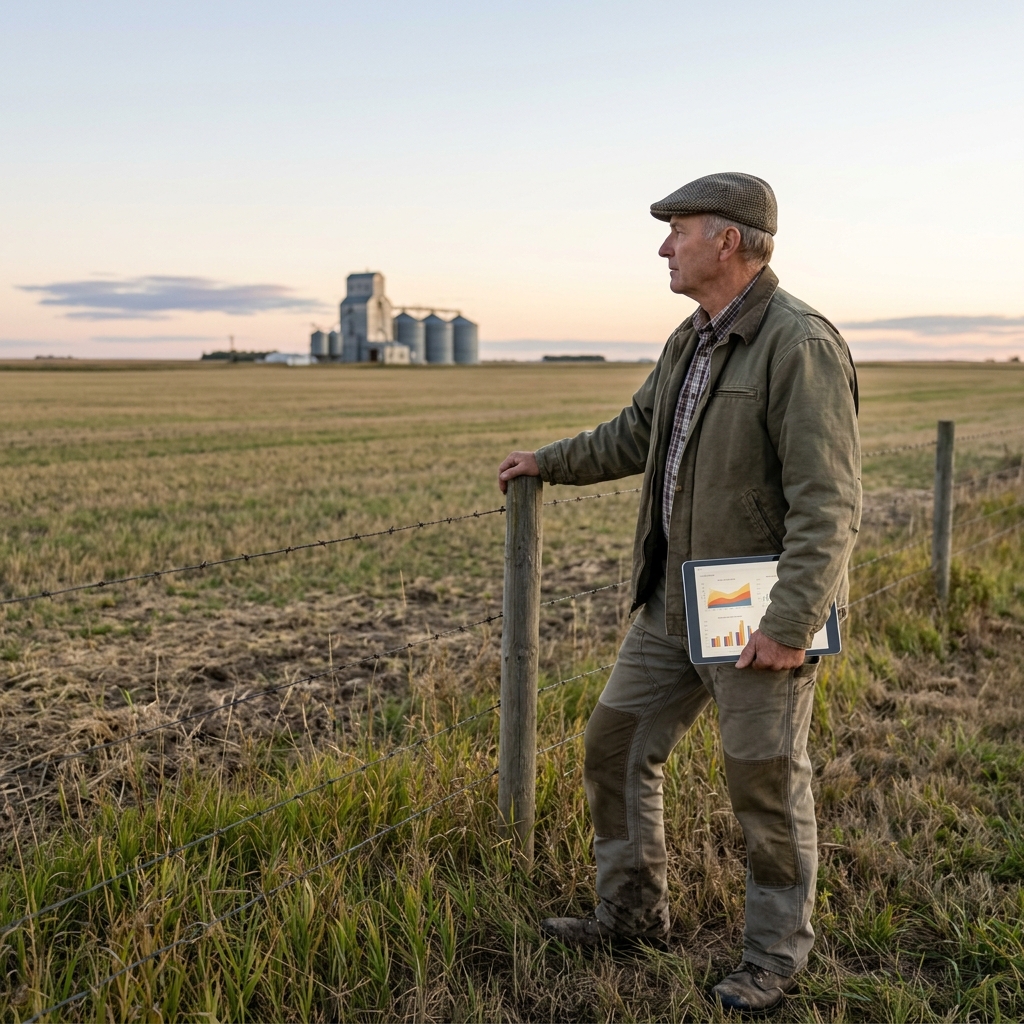
The Variables Behind Agricultural Land Lease Rates That Few Owners Measure
When landowners think about what drives agricultural land lease rates, soil quality and location tend to dominate the conversation. Both matter, but neither one operates in isolation. Farmers evaluate parcels through a much more operational lens, weighing costs, logistics, and cropping potential simultaneously before deciding how much they are willing to pay.
Infrastructure, Drainage, and Access
Physical characteristics that affect a farmer's operating costs have a direct and measurable effect on what a parcel can command per acre. Tile drainage reduces the risk of wet springs delaying planting, which translates into a concrete yield advantage that experienced farmers will pay a premium to secure. Consider the following factors and how they actually move the needle on farm rent per acre:
Tile drainage: well-drained parcels can add $10 to $30 per acre to competitive bids in moisture-prone regions like Manitoba and parts of Ontario
Road and field access: parcels reachable by large equipment without navigating narrow lanes or weight-restricted bridges are operationally cheaper to farm and attract more bidders
Field shape and obstacles: irregular boundaries, drainage ditches, and power line corridors reduce workable acreage and push effective cost per productive acre higher for the tenant
Distance from existing operations: farmers routinely discount parcels more than 20 to 30 kilometres from their home quarter because fuel, labour, and logistics costs erode margins
Fence condition and water access: for mixed or grazing operations, these translate directly into setup costs that tenants mentally subtract from their maximum bid
How Crop Demand Cycles Quietly Reshape Rental Value
A parcel's suitability for high-demand crops shifts its rental ceiling in ways that soil maps alone cannot predict. When canola prices strengthen, farmland rental rates in Canada for parcels with heavy clay-loam soils in Saskatchewan and Alberta tend to climb faster than regional averages suggest, because farmers running canola-heavy rotations are competing for limited suitable land. The same parcel might hold a modest rate in a pulse-dominated rental market, simply because regional cropping economics have changed. Canada's crop outlook reports consistently show how commodity price cycles ripple directly into what farmers can justify paying for access to specific soil types.
Timing, Market Exposure, and Why Private Deals Underperform
Even a well-priced listing on good land can underperform if it enters the market at the wrong moment or reaches only a narrow pool of tenants. Landowners who rely on word-of-mouth or a single existing relationship are not discovering market value; they are accepting whatever one tenant is willing to offer, which is rarely the ceiling.
When You List Is as Important as What You List
Farmers begin securing land for the following season well before winter. Listings that enter the market between August and November tend to attract the most qualified, motivated bidders, because operators are actively planning rotations, equipment deployment, and cash flow at that point. Land listed in January or February often lands in front of farmers who have already committed their budget elsewhere or filled most of their acreage needs. Timing your farmland listing is not a minor logistical detail; it is a direct lever on the quality and volume of bids a parcel receives. Farm Credit Canada's rental rate data shows meaningful variation in effective rates across provinces, which reflects not just soil quality differences but also how actively and broadly individual parcels are marketed to potential tenants.
The Cost of a Thin Bidder Pool
Private negotiations almost always result in rates anchored to what the existing tenant expects to pay, rather than what the open market would bear. When only one or two farmers know a parcel is available, the landowner has no way to know whether the offered rate is fair or simply the lowest number that the tenant thought they could get away with. Farmland rental auctions resolve this directly: when verified farmers bid against each other for access to a parcel, the rate that emerges reflects genuine demand rather than a single operator's negotiating position. This is why competitive bidding consistently produces rates above what landowners were previously receiving through private arrangements, particularly in regions like Ontario and Alberta, where demand for productive acreage routinely outpaces available supply.
Regional Rate Differences and What They Actually Signal
Farm lease rates in Ontario, Saskatchewan agricultural land lease values, and Manitoba farmland rental rates do not differ simply because soil types vary across provinces. They reflect a convergence of local commodity infrastructure, transportation costs, processing facility proximity, and how actively parcels in each region are exposed to a competitive tenant market.
Province-Level Patterns Worth Understanding
In Ontario, proximity to processing facilities and the density of cash crop operators creates sustained competition for quality parcels, which pushes the average farm rent per acre above national benchmarks in many counties. Alberta's irrigated parcels carry significant premiums over dryland equivalents because the yield stability they provide reduces a farmer's crop insurance exposure. In Saskatchewan, parcel size and shape matter considerably: large, square, obstacle-free fields attract premium bids because they reduce per-bushel operating costs in a province built on high-volume grain farming. Farmland value research from Farm Credit Canada reinforces that these localized pressures explain rate divergence as clearly as soil productivity scores do. Landowners who benchmark only against a provincial average, rather than understanding the specific drivers in their area, consistently underestimate what their parcel can actually attract.
The Role of Transparent Pricing in Closing the Gap
Transparent farmland rental pricing tools give landowners something private negotiations never can: visibility into what the market is actually willing to pay for a specific parcel, at a specific time, given current demand. Platforms like Land4Rent surface this data through live competitive bidding, where verified farmers set the rate through their own bids rather than through a back-and-forth with a single tenant. The result is a rate that landowners can defend and, more importantly, one that reflects genuine market conditions rather than historical habit. For landowners managing land as a long-term farmland leasing vs buying decision, understanding what the market will pay today is foundational to any meaningful return-on-asset calculation.
Conclusion
Conclusion
Farmland lease rates are not static, and they are certainly not determined solely by soil quality or provincial averages. Drainage infrastructure, crop demand cycles, listing timing, field logistics, and the depth of your bidder pool all quietly shift what your land can command. Landowners who account for these variables, and who expose their parcels to a genuinely competitive market, consistently capture higher rates than those relying on informal benchmarks or single-tenant negotiations. If your current rate has not been tested against real market demand recently, there is a reasonable chance it is underperforming. Competitive bidding is changing farmland leasing in Canada, and landowners who engage with that shift are the ones closing the gap between what their land is worth and what they are actually receiving.
List your parcel on Land4Rent and let verified farmers show you what your land is actually worth in today's market.
Frequently Asked Questions (FAQs)
What factors determine farmland lease rates in Canada?
Farmland lease rates are shaped by soil productivity, drainage quality, field accessibility, parcel size and shape, proximity to grain handling infrastructure, regional commodity demand, and the timing and breadth of market exposure when the land is listed.
What is the average farm rent per acre in Canada?
Average farm rent per acre varies significantly by province and parcel quality, ranging roughly from $30 to $50 per acre in parts of Saskatchewan to over $200 per acre for prime cash crop land in southwestern Ontario, with irrigated parcels in Alberta often exceeding dryland equivalents by a substantial margin.
How do farmland rental auctions work?
In a farmland rental auction, verified farmers submit competitive bids for access to a listed parcel, and the highest qualifying bid sets the lease rate, replacing private negotiation with a transparent, demand-driven process that reflects actual market conditions.
What should be included in a farm lease agreement?
A farm lease agreement should clearly define the lease term, annual rent per acre, permitted crops or land use, maintenance responsibilities for drainage and fencing, payment schedule, renewal terms, and conditions for early termination.
What are the best farmland rental platforms in Canada?
The most effective farmland rental platforms in Canada are those that combine verified listings, competitive bidding or transparent rate discovery, automated lease generation, and secure payment processing in a single integrated system purpose-built for agricultural leasing.

.png)


.svg)


.svg)