%20(1).svg)

.svg)

Introduction
Farmland leasing in Canada should be straightforward. A landowner has productive acreage. A farmer needs reliable access to it. Both parties want a fair, documented arrangement that holds up season after season. Yet in practice, inconsistency in farmland rental rates, lease terms, tenant screening, and payment processes creates friction that costs both sides time, money, and trust. Consistency in lease agreements is not a bureaucratic nicety. It is the foundation of a functional leasing relationship that protects everyone involved.
This guide walks through the key touchpoints in the farmland leasing cycle where inconsistency most commonly causes problems, and explains what a structured, standardized approach looks like at each stage. Whether you are a landowner managing multiple parcels or a farmer planning your next growing season, understanding why consistency matters, and how to achieve it, is essential knowledge in the Canadian agricultural land market.
Why Inconsistency in Farmland Leasing Is a Real Financial Risk
Farmland leasing problems rarely announce themselves upfront. They tend to surface mid-season, when a verbal understanding proves unenforceable, or at renewal time, when a landlord discovers their rates are significantly below market. The root cause in most cases is the same: informal, fragmented leasing practices that introduce unpredictability into what should be a stable, documented process.
In Canada's agricultural market, where land values in regions like Ontario, Alberta, and British Columbia have risen sharply over the past decade, the gap between a poorly negotiated lease and a market-aligned one can represent thousands of dollars per year. For farmers, the risk runs in the opposite direction. Unstable lease terms or unclear renewal conditions can disrupt multi-year cropping plans and threaten the viability of entire operations.
The Most Common Sources of Leasing Inconsistency
Understanding where inconsistency enters the process helps both parties recognize and address it before it causes damage. The most frequent pain points in traditional farmland leasing include the following areas:
- Informal pricing: Rates set through word-of-mouth or personal relationships often lag behind actual market values, leaving landowners undercompensated.
- Unverified tenants: Leasing to unvetted farmers introduces operational and financial risk that a consistent farm tenant screening process is designed to eliminate.
- Vague lease terms: Agreements that omit key clauses around land use, maintenance responsibilities, or renewal conditions create disputes that are expensive to resolve.
- Manual payment handling: Collecting rent through cash or personal cheques leaves no reliable audit trail and creates opportunities for missed or delayed payments.
- One-off negotiations: When every lease is negotiated from scratch without a standard framework, outcomes vary wildly and neither party can plan with confidence.
The Cost of Getting It Wrong
For landowners, the consequences of inconsistent leasing practices are primarily financial. Below-market rental rates compound year over year, especially on multi-year leases with no escalation clause. But the non-financial costs matter too. Disputed leases, damaged land, or tenants who abandon their obligations mid-season can take months to resolve through legal channels, consuming time and legal fees that dwarf the original lease value.
Farmers face a different but equally serious set of risks. Without consistent, documented lease terms, they cannot secure financing against leased land, cannot plan input purchases confidently, and may lose access to land they have farmed productively for years simply because the arrangement was never formalized. Landowner rights and tenant protections both depend on a written, enforceable agreement being in place from day one.
What Consistency Actually Looks Like
Consistency in agricultural leasing does not mean rigidity. It means applying the same standardized framework across every stage of the process so that both parties know what to expect. A written land rental agreement with clearly defined terms, a transparent pricing mechanism, and a reliable payment process together constitute the minimum standard for a professional leasing relationship in today's Canadian farmland market.
Consistent Pricing: The Foundation of Fair Farmland Leasing
Rental pricing is where inconsistency hits hardest and earliest. In traditional leasing markets, rates are often set through private negotiation, personal relationships, or outdated precedent. The result is that comparable parcels in the same region can carry wildly different rents, with neither landowner nor farmer having confidence that they are dealing at fair value.
Why Market-Driven Pricing Matters
A consistent bidding process for farmland solves the pricing problem by replacing subjective negotiation with competitive, transparent market signals. When verified farmers bid openly on listed parcels, the resulting rate reflects genuine demand for that specific land at that specific time. This approach benefits landowners by ensuring they are not leaving money on the table, and it benefits farmers by establishing a price that can be justified, financed against, and planned around.
Provinces like Ontario and Alberta have seen significant farmland value appreciation in recent years, and farmland rental price agreements that fail to reflect current market conditions are a persistent problem in regions where traditional leasing norms still dominate. A structured auction or competitive bidding model corrects this by anchoring rates to live market demand rather than historical relationships or informal expectations.
Consistent Farmland Rental Pricing Across Regions
One of the practical challenges for landowners managing parcels across multiple provinces is that leasing norms vary significantly. Consistent farmland rental pricing in Ontario may look different in absolute dollar terms than it does in Saskatchewan or British Columbia, but the underlying principle is the same. A pricing mechanism that is transparent, documented, and market-tested delivers better outcomes than one that relies on personal connections. Platforms built around farmland auctions bring this discipline to every listing, regardless of geography.
Protecting Long-Term Land Value
Consistent pricing does more than protect a single season's income. When farmland is consistently leased at market rates, it establishes a documented rental history that supports accurate land valuation over time. This matters enormously when landowners seek financing, consider selling, or need to demonstrate responsible management to family members or estate beneficiaries. Consistent land lease returns in Canada are not just an income story. They are an asset management story.
Consistent Lease Agreements and Digital Platform Solutions
Even the best-negotiated rental rate is meaningless if the underlying agreement is poorly drafted. A lease that omits critical clauses, uses ambiguous language, or fails to address foreseeable scenarios is not a protective document. It is a liability. Consistent lease agreement generation means producing documents that meet the same structural and legal standard every time, regardless of the parcel size or the length of the relationship between the parties.
What Belongs in Every Farm Lease Agreement
Navigating farm leases requires attention to a set of core clauses that should appear in every agreement, from a small grain farm in Manitoba to a large mixed operation in British Columbia. These include rent amount and payment schedule, permitted land uses, maintenance and repair obligations, renewal and termination conditions, and provisions for what happens in the event of crop failure or natural disaster. Writing a farm lease agreement with these sections consistently included reduces the likelihood of disputes and gives both parties a clear framework to operate within.
When lease generation is handled manually or informally, key clauses get dropped, language varies, and enforceability suffers. Standardized templates that are customized to each transaction provide the best of both worlds: structural consistency and transactional specificity.
How Consistent Lease Agreement Generation Works in Practice
A structured approach to lease generation typically involves a guided input process where the landowner or platform administrator answers a defined set of questions about the property, the tenancy, and the commercial terms. The answers populate a legally reviewed template that produces a complete, binding document without requiring the landowner to start from a blank page. This is the model that digital leasing platforms are built around, and it is precisely what makes consistency in end-to-end lease management achievable at scale. Every lease produced through the same process carries the same structural integrity, regardless of how many parcels are under management.
Key Terms That Cannot Be Left to Chance
Certain provisions in farm leases require particular care because their absence creates disproportionate risk. Renewal terms are one example. A lease that is silent on renewal rights can leave a farmer unsure of their standing from one year to the next, and a landowner without the legal clarity needed to transition to a new tenant. Understanding the key terms in Canadian farm commercial leases is essential for anyone entering into a multi-year arrangement, and ensuring those terms appear consistently across all agreements is a baseline standard of professional land management.
Consistent Payments and Ongoing Lease Management
A lease agreement only works if its financial obligations are met reliably. Inconsistent or untracked payment processes are a common failure point in informal farmland leasing, creating disputes over what was paid, when, and how. In professional leasing relationships, payment processes should be as standardized as the agreements that govern them.
Why Consistent Lease Payment Processing Matters
Consistent lease payment processing provides both parties with a documented, auditable record of every transaction. For landowners, it eliminates the ambiguity of cash payments and the administrative burden of chasing overdue rent. For farmers, it provides proof of payment that can be referenced in any dispute and supports the financial record-keeping required by lenders and accountants. A platform that manages payments within the same system as the lease agreement itself closes the gap between the contractual obligation and its fulfilment, creating a single source of truth for the entire leasing relationship.
Automated payment systems also support planning on both sides. When a farmer knows their payment schedule is locked in and processed predictably, they can manage cash flow with confidence. When a landowner receives payments on a known schedule, they can manage their own financial commitments accordingly. This level of predictability is simply not achievable through informal payment arrangements.
Tracking Leases Across Multiple Parcels
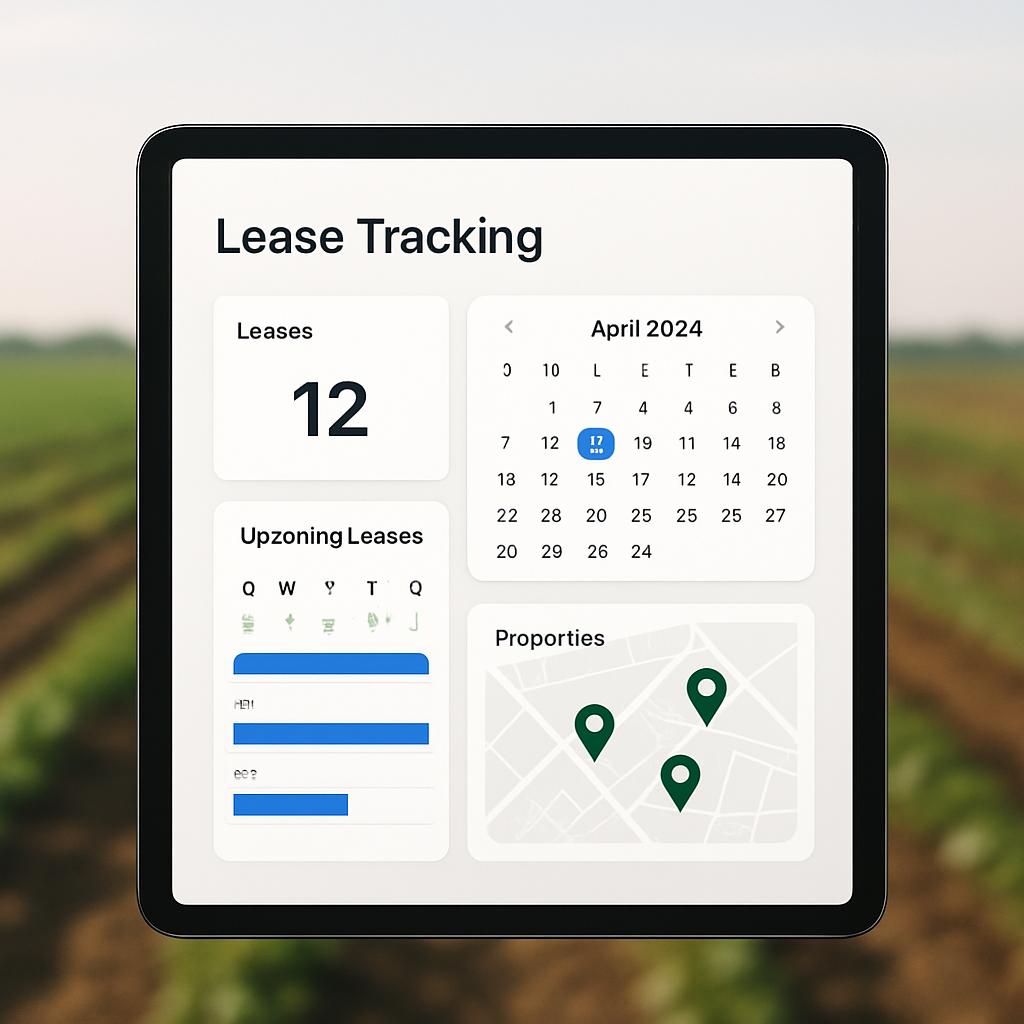
For landowners with more than one property under lease, management complexity multiplies quickly. Different tenants, different payment dates, different lease terms, and different renewal timelines become very difficult to track without a centralized system. Tracking farmland leases in Canada through a single digital dashboard gives landowners visibility across their entire portfolio, reducing the risk of missed renewals, overlooked payments, or lapses in coverage that can leave land under-managed or in legal grey areas.
The Role of Verified Tenants in Payment Consistency
Payment reliability is not just a systems problem. It is also a tenant quality problem. Consistent payment outcomes begin with ensuring that the farmers entering into lease agreements are financially capable and professionally credible. A rigorous tenant verification process, integrated into the leasing platform itself, is what connects the structural consistency of the agreement to the behavioral consistency of the tenant. When both elements are present, landowners have a defensible foundation for expecting reliable rental income season after season.
How a Structured Digital Platform Delivers Consistency at Every Stage
The fragmentation that characterizes traditional farmland leasing is not inevitable. It is a product of relying on informal channels, manual processes, and undocumented relationships to manage what are, in many cases, significant financial assets. A structured digital marketplace addresses every one of these failure points by bringing the entire leasing process under a single standardized framework.
From Listing to Signed Lease: End-to-End Consistency
The value of an end-to-end leasing platform is that consistency is built into each step of the process rather than left to the discretion of the individual parties. Digital farmland leasing platforms that cover listing, bidding, lease generation, and payment processing within a single system eliminate the handoff gaps where inconsistency typically enters. A landowner who lists a property on such a platform receives market-driven pricing, a verified tenant pool, a standardized lease, and automated payment tracking without having to coordinate multiple third-party services or rely on informal arrangements at any stage.
This is the model that Land4Rent is built around. Landowners list verified properties, receive competitive bids from screened farmers, generate customized leases through a guided process, and manage payments through a secure, trackable system. The result is a leasing experience where every transaction, regardless of parcel size or location, is governed by the same standards of transparency and accountability.
Consistency as a Competitive Advantage for Landowners
Landowners who operate with consistent, documented, and transparent leasing practices are better positioned in every dimension that matters. They attract better tenants because professional farmers prefer working with organized landlords who use clear processes. They achieve better pricing because competitive, transparent bidding surfaces genuine market demand. And they protect their long-term asset value because a documented rental history is a meaningful component of farmland valuation. The advantages of digital over traditional leasing come down, in large part, to this: consistency is built into the platform rather than dependent on individual effort.
Consistency as Security for Farmers
For farmers, the benefits of a consistent leasing environment are equally concrete. Farmland rental consistency in Alberta, Canada and other high-demand agricultural regions means that a farmer can plan a multi-year cropping rotation with confidence in their land access. It means that the lease they sign is comprehensive enough to protect their investment in soil amendments, drainage improvements, or other on-farm capital expenditures. And it means that disputes, when they arise, can be resolved by reference to a documented record rather than competing recollections. The structured farmland leasing process is not just a convenience. It is the infrastructure that makes long-term farming operations viable.
Conclusion
Consistency in farmland leasing is what separates a productive, long-term agricultural relationship from a fragile arrangement that breaks down at the first point of stress. Whether the issue is pricing, documentation, tenant quality, or payment reliability, the answer is the same: standardize the process, document everything, and use platforms and tools designed specifically for agricultural leasing. Landowners who adopt consistent practices protect their income, their land value, and their time. Farmers who work within consistent leasing frameworks protect their operations, their planning horizons, and their access to the land they depend on. In a market as financially significant and seasonally unforgiving as Canadian farmland, consistency is not a best practice. It is a baseline requirement.
Ready to bring consistency to your farmland leasing? Explore Land4Rent's end-to-end leasing platform and connect with verified farmers or landowners across Canada today.
Frequently Asked Questions (FAQs)
What is consistency in farmland leasing?
Consistency in farmland leasing refers to applying the same standardized processes across pricing, documentation, tenant screening, and payment handling in every leasing transaction. It reduces disputes, protects both parties, and builds trust over the long term.
How can landowners achieve consistent rental income in Canada?
Landowners can achieve consistent rental income by using market-driven pricing mechanisms, standardized lease agreements with clear payment schedules, and digital platforms that automate and track payments throughout the lease term.
Why is consistency important in agricultural lease agreements?
Inconsistent agricultural lease agreements often omit critical clauses, use ambiguous language, or fail to address renewal and termination conditions, all of which create legal and financial risk for both the landowner and the farmer.
How does a consistent bidding process benefit farmland owners?
A consistent bidding process ensures that rental rates are determined by genuine market demand rather than informal negotiation, which helps landowners capture fair market value and establish a documented pricing history for their land.
Can online farmland auctions provide consistent rental rates?
Yes. Online farmland auctions create transparent, competitive pricing environments where verified farmers bid on listed parcels, producing rates that reflect real market conditions rather than personal relationships or outdated precedent.
How does consistent lease agreement generation work?
Consistent lease agreement generation typically involves a guided input process where standardized questions populate a legally reviewed template, producing a complete, binding document with the same structural integrity every time it is used.
Is consistent farmland leasing possible through a digital marketplace?
Yes. A well-structured digital marketplace applies the same standards to listing verification, tenant screening, lease generation, and payment processing across every transaction, making consistency achievable at scale rather than dependent on individual effort.
What makes a farmland rental marketplace consistent and reliable?
A reliable farmland rental marketplace combines verified listings, screened tenants, standardized lease templates, and automated payment processing within a single integrated system, eliminating the handoff gaps where inconsistency typically enters traditional leasing.
How does Land4Rent ensure consistency in lease transactions?
Land4Rent verifies both properties and tenants before they appear on the platform, uses a competitive auction model for pricing, offers guided lease generation, and manages payments within the same system, creating a consistent, documented process at every stage.
Why is consistent pricing important in farmland rental auctions?
Consistent pricing in farmland rental auctions ensures that both landowners and farmers are operating with accurate, market-tested rate information, which supports fair transactions, reliable financial planning, and a documented rental history that strengthens long-term land value.


.png)


.svg)


.svg)