%20(1).svg)

.svg)

Introduction
Most farm lease agreements spend pages detailing payment schedules and rental due dates while dedicating almost nothing to how the land itself should be managed. For landowners across Canada, this imbalance creates real risk. Without defined operational standards, tenants may skip crop rotation, misapply chemicals, or sublease parcels without permission, and the landowner has little contractual leverage to intervene. The gap between what a lease covers financially and what it covers operationally is where long-term land value quietly erodes. Setting clear operational standards before signing is the single most practical step a landowner can take to protect both the condition of their farmland for rent and the stability of their rental income.
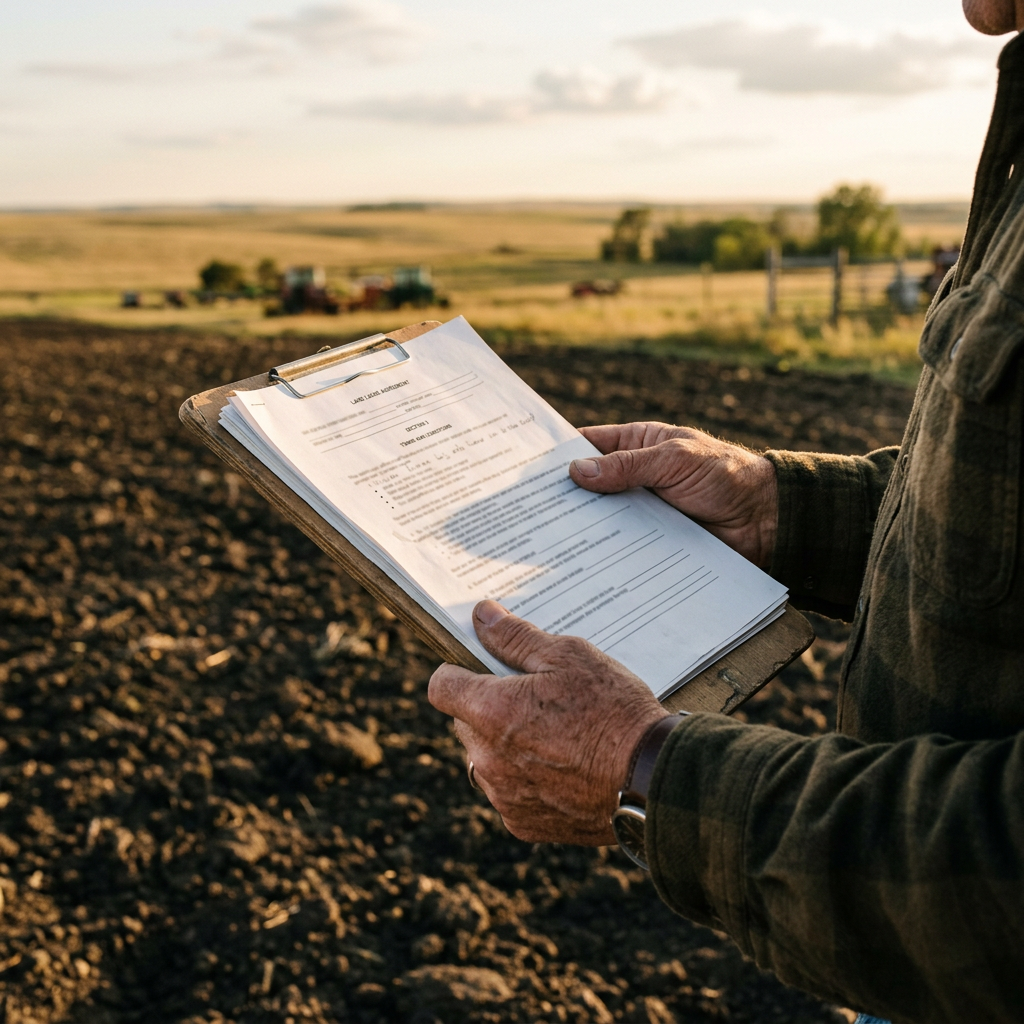
What Operational Standards Mean in Farm Leasing
Operational standards are the specific, enforceable expectations that govern how a tenant uses and manages leased agricultural land. Unlike payment terms, which address the financial side of a lease, operational standards address the physical side: soil health, land use boundaries, chemical application practices, equipment storage, environmental compliance, and more. These standards give structure to the day-to-day reality of farming on someone else's property, and they protect the landowner from damage that can take years and significant capital to reverse.
Why Payment Terms Alone Are Not Enough
A lease that only locks in rental rates and due dates leaves the most important asset, the land itself, unprotected. Consider what happens when a tenant continuously plants the same crop without rotating. Crop rotation is fundamental to maintaining soil fertility and breaking pest cycles, yet without a written requirement, a landowner has no grounds to enforce it. The same applies to drainage modifications, unauthorized tree removal, or excessive tillage that accelerates erosion.
Payment compliance and land stewardship are two entirely separate obligations. A tenant can pay on time every month while simultaneously degrading soil organic matter, compacting fields with oversized equipment, or applying restricted pesticides in ways that violate provincial regulations. If the lease does not explicitly address these activities, the landowner bears the consequences when the land is returned in diminished condition. This is why farm lease agreements fail in small details, not in the headline numbers.
The Long-Term Cost of Undefined Expectations
Soil degradation is not always visible in the first year. A landowner may not notice declining organic matter, increased salinity, or compacted subsoil layers until a new tenant takes over and reports yield problems. At that point, remediation can involve years of cover cropping, targeted fertilization, and restricted use, all at the landowner's expense.
Undefined expectations in a lease can also depress future farmland rental rates, because prospective tenants will factor in the cost of rehabilitating neglected soil when submitting bids. This is one of the reasons recognizing signs of soil degradation early matters so much for long-term returns.
Essential Operational Standards Every Landowner Should Define
Knowing that operational standards matter is one thing. Knowing which ones to include is where most landowners need guidance. The following areas represent the highest-impact clauses to build into any agricultural land for lease agreement. Each one addresses a specific risk that, left unmanaged, can erode land quality and diminish the property's earning potential over time.
Soil Health and Crop Management Requirements
Soil health clauses are arguably the most important operational standards in any farm lease. They protect the productive capacity of the land and ensure tenants follow soil management duties that preserve fertility across growing seasons. Without these clauses, there is no enforceable mechanism to prevent extractive farming practices that prioritize short-term yield at the expense of long-term soil structure.
- Crop rotation minimums: Require tenants to rotate crops on a defined cycle to prevent nutrient depletion, reduce pest pressure, and maintain balanced soil biology
- Soil testing obligations: Mandate annual or biennial soil testing at the tenant's expense, with results shared directly with the landowner for ongoing monitoring
- Cover cropping expectations: Specify whether cover crops must be planted after harvest, including approved species and seeding timelines
- Chemical application limits: Define which herbicides, pesticides, and fertilizers are approved for use and set maximum application rates in accordance with provincial guidelines
- Tillage restrictions: Outline acceptable tillage methods and prohibit practices that cause excessive soil disturbance or compaction on vulnerable parcels
Land Use Boundaries and Permitted Activities
Beyond soil management, a well-drafted lease should clearly outline what the tenant is and is not permitted to do with the property. This includes restrictions on subletting any portion of the land, limitations on non-agricultural use such as storage or events, and rules around infrastructure changes like fencing, drainage tiles, or road access modifications. Landowners who skip these clauses often discover unauthorized activities only after significant changes have already been made, and reversing those changes becomes a separate negotiation entirely. A thorough lease, as outlined in guidance on writing a farm lease agreement that holds up in court, prevents these situations before they start.
How Clear Standards Strengthen the Leasing Relationship
Operational standards are sometimes perceived as adversarial, as though the landowner is imposing restrictions that limit the tenant's freedom. In practice, the opposite tends to be true. Clearly defined expectations reduce misunderstandings, eliminate guesswork, and create a shared framework that both parties can reference throughout the lease term. When expectations are defined early in the leasing process, the entire relationship benefits.
Building Accountability Without Micromanaging
The goal of operational standards is not to dictate every farming decision. It is to establish non-negotiable baselines that protect the land while giving the tenant room to operate effectively within those boundaries. A well-structured lease specifies outcomes (maintain soil organic matter above a baseline level, for example) rather than micromanaging methods. This distinction matters, because experienced farmers will resist leases that feel controlling but will respect leases that protect the resource they depend on.
Accountability is easier to maintain when both sides have agreed to measurable standards upfront. Lease reviews become straightforward, inspections feel collaborative rather than confrontational, and renewal discussions are grounded in documented performance rather than differing recollections. Resources like the FCC guide on farmland rental agreements reinforce the importance of detailed, balanced terms for both landowners and tenants.
Reducing Disputes and Protecting Long-Term Returns
Disputes in farm leasing almost always stem from ambiguity. When a lease states that the tenant must "maintain the land in good condition" without defining what that means, both parties interpret it differently. Operational standards replace vague language with specific, verifiable criteria. Instead of "good condition," the lease can require annual soil test results that meet defined thresholds, photographic documentation of field conditions at lease end, or third-party inspections at agreed intervals.
This level of specificity protects long-term rental income. Landowners who maintain well-documented operational standards attract higher-quality tenants, secure better farmland rental rates, and retain the flexibility to adjust lease terms as agricultural conditions evolve. Platforms like Land4Rent support this approach by providing automated lease generation tools that help landowners include the critical details that leases often miss, making it easier to build comprehensive agreements from the start.
Conclusion
Farm leasing works best when landowners treat operational standards as seriously as they treat payment terms. Defining expectations around soil health, crop management, permitted land uses, and environmental compliance creates a lease that protects the land, reduces disputes, and supports stronger long-term returns. The time to set these standards is before the lease is signed, not after problems emerge. For landowners across Canada looking to protect their most valuable agricultural asset, building clear operational standards into every lease agreement is not optional. It is essential.
List your farmland on Land4Rent and use automated lease generation tools to build comprehensive agreements with built-in operational standards.
Frequently Asked Questions (FAQs)
What should be in a farm lease agreement beyond payment terms?
A farm lease agreement should include operational standards covering soil health requirements, crop rotation expectations, chemical application limits, permitted land uses, and inspection or reporting obligations.
How do landowners protect their land through lease terms?
Landowners protect their land by including specific, measurable operational clauses in the lease that define acceptable farming practices and establish consequences for non-compliance.
What operational standards should landowners set in a farm lease?
Landowners should set standards for crop rotation, soil testing frequency, cover cropping, chemical use, tillage methods, subletting restrictions, and infrastructure modification limits.
What are farm rental rates in Canada?
Farm rental rates in Canada vary significantly by province, soil class, and local demand, so landowners should research current regional benchmarks and consider competitive bidding to determine fair market value.
What are the best farm leasing platforms in Canada?
The best farm leasing platforms in Canada offer verified listings, competitive bidding, automated lease generation, and secure payment processing to streamline the entire leasing process for both landowners and tenants.

.png)




.svg)


.svg)