%20(1).svg)

.svg)

Introduction
Soil fertility management shapes everything from seasonal yields to the long-term asset value of Canadian farmland. As input costs climb and sustainability expectations shift, farmers across the Prairies and eastern Canada are weighing organic methods against conventional approaches with renewed seriousness. For tenant farmers and landowners negotiating lease terms, the fertility strategy applied to a parcel directly affects soil health, profitability, and the condition of the land at lease end. The differences between these two approaches run deeper than input labels, touching crop rotation design, nutrient cycling timelines, and the financial risk each party carries across a multi-year agreement.

Understanding the Two Approaches to Soil Fertility
Before comparing outcomes, it helps to clarify what each system actually involves at the field level. Both organic and conventional fertility programs aim to supply crops with nitrogen, phosphorus, potassium, and micronutrients, but they rely on fundamentally different sources, timelines, and management philosophies to get there.
Conventional Fertility: Precision Inputs and Rapid Response
Conventional soil nutrient management centres on synthetic fertilizer programs that deliver plant-available nutrients in precise ratios. Farmers can match application rates to soil test recommendations within narrow margins, which makes nutrient budgeting relatively predictable from season to season. The approach pairs well with high-yield crop plans and allows quick correction of deficiencies identified through soil testing services in Canada.
Speed of availability: Synthetic fertilizers release nutrients in plant-available form almost immediately after application, matching crop uptake windows.
Rate precision: Application equipment can deliver exact pounds per acre of N, P, and K, reducing guesswork around sufficiency levels.
Cost predictability: While fertilizer prices fluctuate with global markets, budgeting per-acre input costs is straightforward within a given season.
Yield ceiling: Conventional programs generally support higher short-term yield ceilings, especially on crops like canola and corn that demand heavy nitrogen.
Organic Fertility: Building Soil Biology Over Time
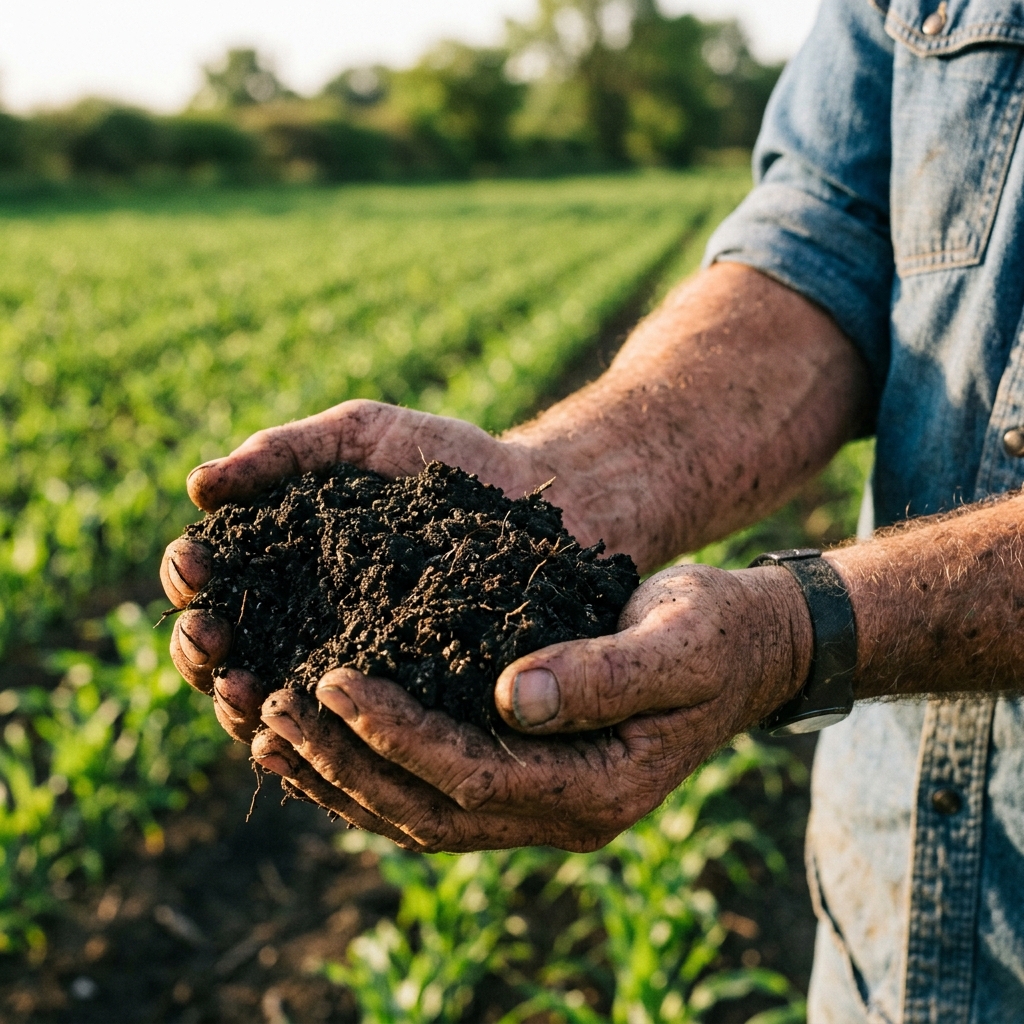
Organic soil management replaces synthetic inputs with biological nutrient sources: compost, green manures, livestock manure, and legume-based crop rotations that fix atmospheric nitrogen. According to Canadian Organic Growers resources, this approach treats the soil as a living system where microbial activity drives nutrient cycling rather than direct chemical supplementation. The trade-off is timing. Nutrients from organic sources become plant-available only after microbial decomposition, which depends on soil temperature, moisture, and biological activity. In Prairie provinces where spring soil temperatures stay low into May, this lag can limit early-season nutrient supply for crops like wheat and canola. Organic fertility tends to build cumulative soil health over multiple rotations rather than delivering immediate season-to-season gains.
Comparing Long-Term Outcomes for Soil and Farm Economics
The practical differences between organic and conventional programs become most visible over multi-year timeframes. A single season rarely tells the full story, which is why soil health assessments at the start and end of a lease period matter so much for both landowners and tenants operating in Canada.
Soil Health Trajectories and Organic Matter
Research from Agriculture and Agri-Food Canada consistently shows that organic systems build soil organic matter faster than conventional systems over five-to-ten year windows. Higher organic matter improves water-holding capacity, reduces compaction risk, and feeds the microbial communities responsible for natural nutrient cycling. For landowners, this translates to improved soil moisture management and a measurably stronger land asset over time.
Conventional systems do not inherently degrade organic matter, but they can if tillage is excessive or if crop rotations lack diversity. The no-till vs conventional tillage debate plays a significant role here. A conventional farm that adopts no-till and includes pulse crops in the rotation can maintain or slowly build organic matter, narrowing the gap with organic operations. The key variable is not the label (organic or conventional) but the actual combination of practices applied each year. Farms that rely on best soil management practices, regardless of certification status, tend to maintain healthier profiles over time.
Cost Structures and Risk Profiles
Conventional fertility programs carry higher direct input costs, often running $80 to $150 per acre for synthetic fertilizer in grain-dominant rotations across Saskatchewan and Alberta. Those costs fluctuate with global nitrogen prices, which have shown sharp volatility since 2021. However, the yield response is generally more predictable and immediate, which helps cash-flow planning on rented land.
Organic systems trade fertilizer bills for labour and management complexity. Cover crops, composting, and longer rotations (often including a full year of green manure) reduce purchased inputs but demand more field passes, tighter timing, and tolerance for lower yields during transition years. Premium pricing for certified organic grain offsets some of this, but lease decisions that impact soil and income should account for the fact that organic premiums are market-dependent and not guaranteed. A tenant farming organically on rented land must plan for the possibility that premiums compress while yield gaps persist.
Fertility Commitments in Farmland Lease Agreements
Where these two approaches intersect most directly with Canadian farmland leasing is in the lease agreement itself. Sustainable farming in Canada depends partly on how clearly landlords and tenants define fertility expectations before the first seed goes in the ground.
What Landowners and Tenants Should Align On
A well-structured lease should specify whether the tenant plans to follow an organic or conventional fertility program, because the implications for land condition at lease end differ substantially. Landowners listing parcels on Land4Rent can use the platform's lease agreement tools to formalize these expectations. Soil pH management, for example, is a detail that often gets overlooked in handshake deals but can cost thousands of dollars to correct if a tenant allows pH to drift below optimal thresholds for subsequent crop plans.
Tenants should document baseline soil conditions through accredited soil testing at the start of any lease. This protects both parties. If a landowner later claims soil quality degradation, the tenant has evidence of starting conditions. If a tenant builds organic matter through cover crops and careful management, that investment is documented too. Lease clauses addressing soil management duties protect the asset for both the owner and the farmer working the land.
Regional Considerations Across Canadian Provinces
Fertility management decisions are not one-size-fits-all across Canada's diverse agricultural regions. In the Prairie provinces, short growing seasons and alkaline soils push many operations toward conventional programs that deliver nutrients quickly in a narrow planting window. Saskatchewan's emphasis on legume-based soil improvement programs shows that even within conventional frameworks, biological nitrogen fixation plays an important role.
In Ontario and Quebec, longer seasons and more moderate soil pH conditions make organic transition more feasible. Cover crops establish more reliably in fall, and the proximity to premium organic markets in urban centres like Toronto and Montreal improves the economic case for organic certification. Landowners in these regions may find that tenants proposing organic programs offer a compelling stewardship story alongside competitive rental bids. Understanding your regional soil type helps determine which fertility approach makes practical sense for a given parcel.
Conclusion
Neither organic nor conventional soil fertility management is universally superior. The right approach depends on regional growing conditions, the farmer's operational capacity, market access for organic products, and how the lease agreement structures accountability for land stewardship. What matters most is that both landowners and tenants commit to transparent fertility planning, baseline soil testing, and lease terms that reflect the real-world costs and benefits of the chosen program. Land4Rent helps Canadian landowners and farmers align on these details from the start, matching verified parties through a platform built around responsible, long-term agricultural land management.
Explore Land4Rent to connect with verified farmers and landowners who share your commitment to productive, well-managed farmland.
Frequently Asked Questions (FAQs)
How do organic soil management practices compare to conventional methods?
Organic practices rely on biological nutrient sources like compost and legume rotations that build soil health gradually, while conventional methods use synthetic fertilizers for faster, more precise nutrient delivery at higher direct input cost.
What causes soil nutrient depletion?
Continuous cropping without adequate fertilization, lack of crop rotation diversity, excessive tillage, and removal of crop residues all contribute to the progressive depletion of essential soil nutrients.
How does cover cropping improve soil health?
Cover crops protect soil from erosion, add organic matter as residues decompose, fix atmospheric nitrogen when legumes are included, and support microbial communities that drive natural nutrient cycling.
How does soil pH affect crop yields in Canadian farmland?
Soil pH determines nutrient availability to plant roots, and when pH drifts outside the optimal range of roughly 6.0 to 7.5 for most field crops, key nutrients like phosphorus become chemically locked and unavailable despite being present in the soil.
What soil fertility practices should tenants follow on rented farmland in Canada?
Tenants should conduct baseline soil tests, follow a documented fertility plan agreed upon in the lease, maintain crop rotation diversity, and return the land in equal or better condition than at lease commencement.


.png)



.svg)


.svg)