%20(1).svg)

.svg)

Introduction
Not every landowner holding comparable acreage walks away with comparable returns. The gap between strong and mediocre rental outcomes is real, it is measurable, and it rarely comes down to luck. Across Canadian farmland markets, the landowners who consistently outperform their peers share a recognizable set of habits, decisions, and tools. Understanding those patterns is the first step toward closing the gap and building a more reliable, higher-yielding leasing strategy.
The Patterns That Separate High-Performing Landowners
When you look closely at landowners who consistently secure strong lease terms and reliable tenants, a few clear patterns emerge. They are not simply lucky with their geography or soil quality. They make deliberate choices about how they bring land to market, who they lease to, and how they structure their agreements.
They Understand What Their Land Is Actually Worth
High-performing landowners do not guess at their farmland rental income per acre. They research current market data, track regional trends, and benchmark their expectations against real comparable transactions. According to FCC's 2024 farmland rental rate data, rental values across Canada have shifted meaningfully in recent years, and landowners who stay current on those figures are better positioned to set competitive asking rates from the start.
Those who underperform tend to anchor their expectations to outdated figures, often what a neighbor was paid five years ago, or what a longtime tenant agreed to without any negotiation. That approach leaves real money on the table, year after year.
They Use Competitive Bidding to Set Rates
One of the most consistent differentiators among top-performing landowners is their willingness to let the market, not private negotiation, determine price. Farmland rental auctions versus fixed-rate leases is not just a theoretical comparison. In practice, competitive bidding surfaces what farmers are actually willing to pay based on current input costs, commodity prices, and land productivity.
When multiple verified farmers bid against each other, the result is a rate driven by genuine market demand rather than one party's negotiating leverage. That shift alone can meaningfully improve farmland rental yield in Canada without requiring a landowner to change anything about the land itself.
How Tenant Quality Shapes Long-Term Returns
A higher per-acre rate means nothing if the tenant damages soil health, misses payments, or abandons a lease mid-term. The landowners who consistently achieve better outcomes understand that tenant quality is at least as important as rental rate.
Verified Tenants Reduce Costly Surprises
Working with verified farmland tenants in Canada reduces the risk of late payments, disputes, and land misuse. Unverified tenants introduce uncertainty that quietly erodes returns over time. A single bad lease can take years to recover from, particularly if soil damage or legal disputes are involved. Before leasing farmland, it is worth asking the right questions about any prospective tenant's farming practices, as outlined by resources focused on soil health questions non-operator landowners should ask.
Platforms that vet tenants before they can bid create a meaningful filter. Landowners who rely on those systems spend far less time managing problem relationships and far more time collecting predictable income.
Lease Agreement Quality Protects Income
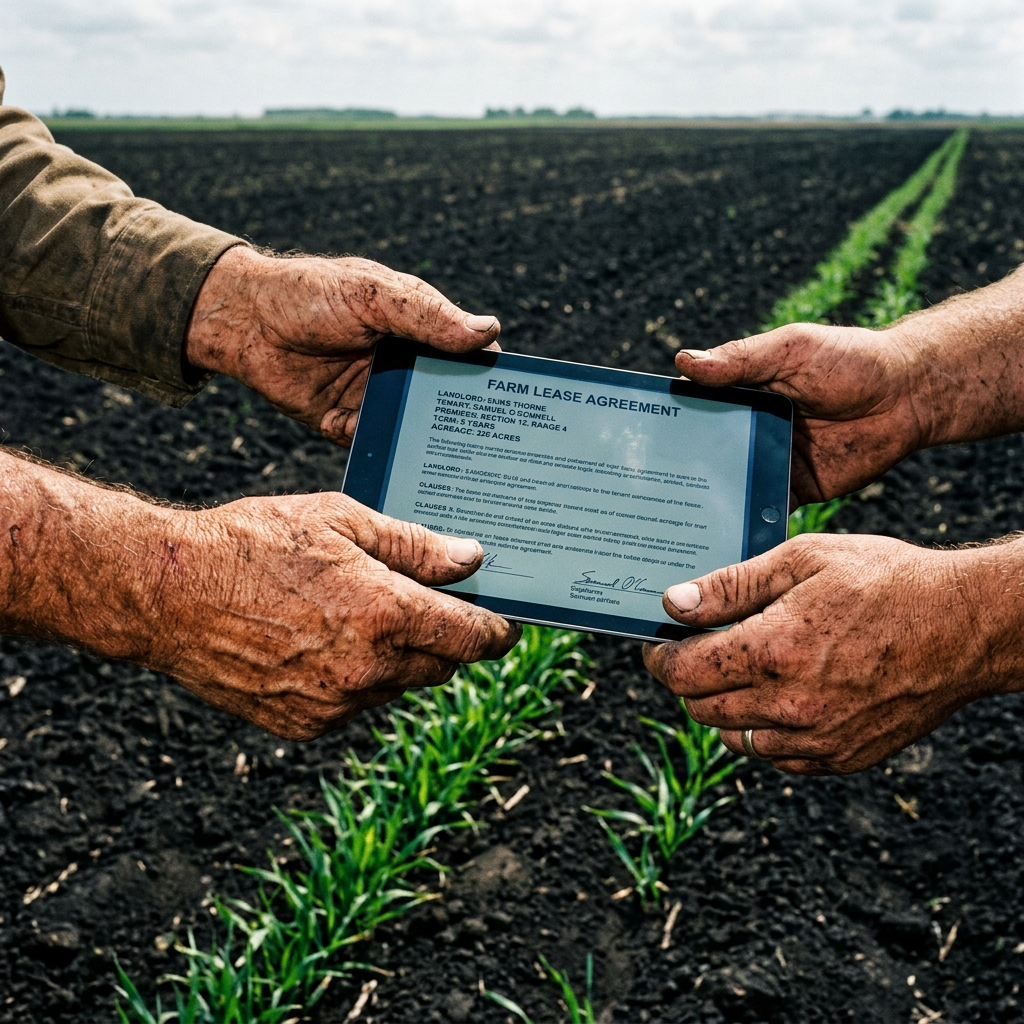
A weak lease is an invitation for disputes. High-performing landowners treat their farm lease agreement as a core business document, not a formality. They ensure it clearly defines payment terms, permitted land use, maintenance responsibilities, and renewal conditions. A well-structured lease does more than protect the landowner legally. It sets expectations from day one and reduces the friction that erodes landlord-tenant relationships over time.
The Role of Process and Platform Choice
The tools and processes a landowner uses to bring land to market have a direct effect on outcomes. A transparent farmland leasing process signals professionalism, attracts higher-quality tenants, and produces documentation that holds up if disputes arise.
Digital Platforms Change What Is Possible
Digital farmland leasing platforms have fundamentally changed what a private landowner can accomplish without engaging a broker or agent. Listing, bidding, lease generation, and payment processing can now happen within a single system, with full transaction records at every step. That end-to-end visibility makes it easier to enforce lease terms and provides documentation that protects both parties. Land4Rent operates exactly this way, combining live auction bidding with automated lease generation and secure farmland rental payments managed entirely within the platform.
Consistent Income Requires More Than a Good First Lease
The landowners who build durable, maximized farmland returns year over year treat leasing as an ongoing process, not a one-time transaction. They revisit rates at renewal, monitor competitive farmland rental rates in their region, and use each lease cycle as an opportunity to optimize. Staying passive between lease signings is one of the most common ways landowners quietly underperform relative to their land's actual potential.
Platforms that provide live auction bidding give landowners a built-in mechanism for resetting rates to market each cycle. That alone tends to produce better outcomes than rolling over the same terms with the same tenant indefinitely.
What Underperforming Landowners Have in Common
The patterns on the underperforming side are just as consistent. Landowners who fall short tend to rely on informal arrangements, skip tenant verification, use generic or incomplete lease documents, and avoid the effort of competitive listing in favor of renewing familiar agreements. Some hold onto the belief that keeping a long-term tenant happy means accepting below-market rates. That instinct is understandable, but it is rarely supported by the numbers.
Familiarity Is Not the Same as Security
A longtime tenant relationship can be genuinely valuable. But farmland leasing in Canada is a business relationship, and it should be structured like one. The most effective landowners maintain strong tenant relationships while still conducting each renewal as a proper market exercise. Familiarity and rigor are not mutually exclusive. Landowners who treat every lease cycle as an opportunity to validate their rate, confirm their tenant's standing, and review their agreement terms consistently outperform those who do not.
Soil Health Feeds Rental Value
Landowners who invest in understanding and documenting their soil health before leasing are able to present a more compelling, evidence-backed listing. Farmland with documented productivity data attracts more serious bidders and supports higher rates. Ignoring this step means relying on a tenant's word or a general regional average, neither of which maximizes what the land can command. According to research on rent-to-value ratios for Canadian farmland, land condition and productivity documentation play a measurable role in how leasing outcomes compare across similar parcels.
Conclusion
The gap between high-performing and underperforming landowners is not mysterious. It comes down to market awareness, tenant quality, lease structure, and the systems used to manage the leasing process. Landowners who benchmark their rates, use competitive bidding, work with verified tenants, and maintain clear legally-binding leases consistently outperform those who rely on habit and informal arrangements. The good news is that every one of those variables is within a landowner's control. Finding the right rental platform is often the single highest-leverage step a landowner can take to start closing that performance gap.
Ready to see what your farmland can actually earn? List your land on Land4Rent and let competitive bidding find your real market rate.
Frequently Asked Questions (FAQs)
What factors determine farmland rental rates in Canada?
Farmland rental rates in Canada are shaped by soil quality, regional demand, commodity prices, land productivity history, and whether rates are set through competitive bidding or private negotiation.
How does competitive bidding work for farmland rentals?
Competitive bidding for farmland rentals involves multiple verified farmers submitting offers on a listed parcel, with the final rate determined by genuine market demand rather than a single negotiated figure.
What should I include in a farmland lease agreement?
A farmland lease agreement should clearly define the rental rate, payment schedule, permitted land use, maintenance responsibilities, lease term, and conditions for renewal or early termination.
What are the benefits of leasing farmland instead of selling?
Leasing farmland instead of selling preserves long-term asset value, generates recurring income, maintains ownership for future generations, and allows landowners to benefit from rising land values over time.
How do farmland rental rates differ between Saskatchewan and Ontario?
Ontario farmland lease rates per acre are typically higher than those in Saskatchewan due to greater land scarcity, proximity to markets, and stronger competition among farmers for available acreage.


.png)


.svg)


.svg)