%20(1).svg)

.svg)

Introduction
Farmland leasing in Canada is not a casual transaction. For landowners, it determines whether a parcel generates meaningful income or sits chronically undervalued. For farmers, it shapes whether a season is profitable or a financial drain. Yet across provinces, many leasing arrangements are still struck on informal terms, gut feelings, and secondhand knowledge about what nearby land is going for. Precision farmland leasing changes that equation by anchoring every decision to verifiable, real-world data rather than assumption.
The stakes are high on both sides. A landowner who lists without knowing comparable rental rates may lock in below-market rent for years. A farmer who bids without understanding soil capacity may commit to land that cannot support their intended crop. Accurate land data, covering soil quality, historical productivity, precise acreage, and current market pricing, is the foundation that turns a risky agreement into a productive, long-term partnership.
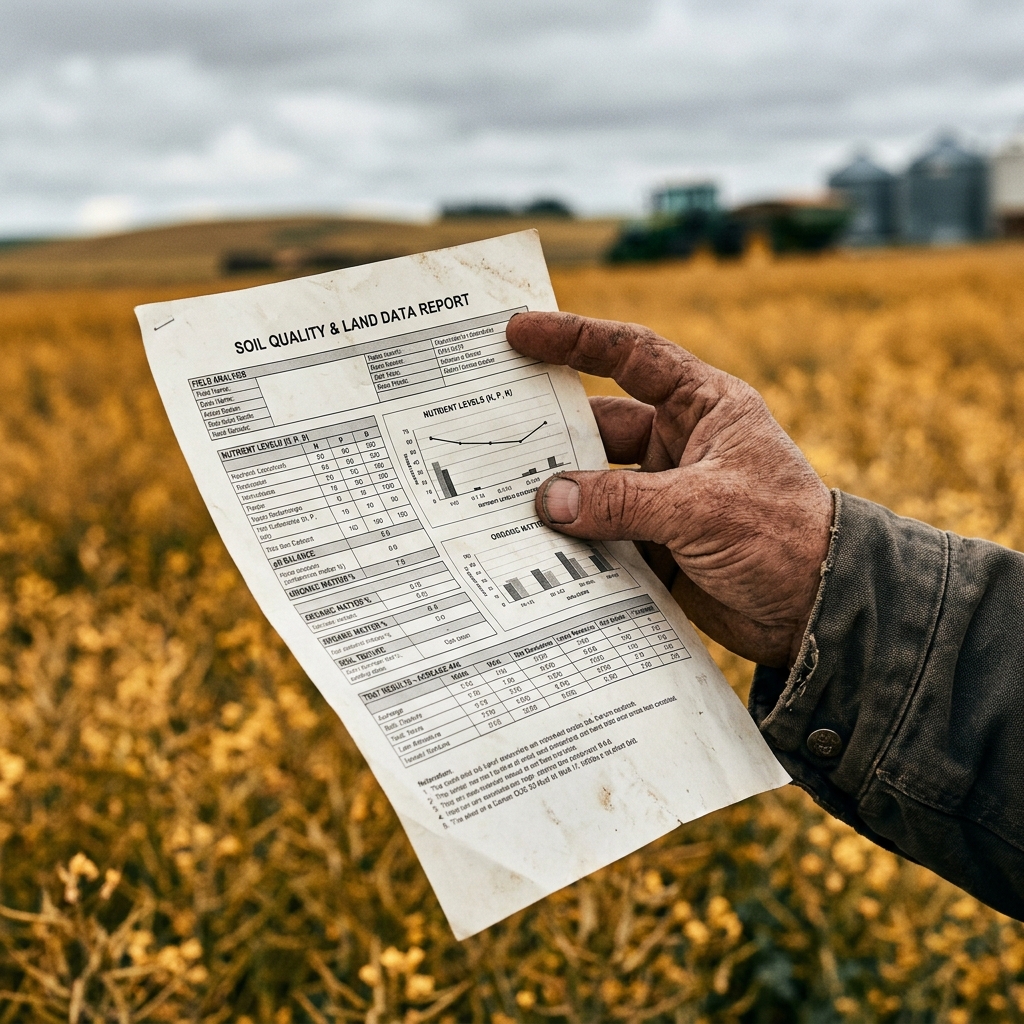
The Types of Land Data That Matter Most Before You Lease
Before any lease is signed, both parties need to work from a shared understanding of what the land actually is. Not what it looks like from the road, and not what the previous tenant paid a decade ago. Data-driven leasing begins with assembling the right information before a listing goes live or a bid goes in.
Key Data Points Landowners Should Gather Before Listing
Landowners often underestimate how much preparation shapes their final rental outcome. A well-documented listing attracts serious farmers, supports stronger bids, and reduces back-and-forth negotiation. Here are the core data points worth collecting before any listing is created:
- Verified acreage: Legal land descriptions and survey records prevent disputes over what is actually being leased and for how much.
- Soil classification: Provincial soil maps and lab tests reveal productive capacity, drainage quality, and long-term yield potential.
- Historical crop yields: Past yield records tied to the parcel give prospective tenants a realistic picture of what the land can produce.
- Infrastructure inventory: Grain bins, tile drainage, access roads, and buildings all affect rental value and should be documented.
- Water and drainage status: Seasonal flooding risk, tile systems, and water access directly influence how usable the land is year-round.
- Existing lease history: Prior terms, tenant relationships, and any soil amendments made during previous tenancies inform fair pricing expectations.
What Farmers Should Verify Before Committing to a Parcel
Farmers entering a competitive leasing situation need more than an aerial photo and a dollar-per-acre number. Soil quality assessment is arguably the most critical pre-commitment step a farmer can take. Understanding organic matter levels, pH balance, and compaction history determines whether the land can support the intended rotation at the expected margin. Resources like Canada's National Soil Information System provide publicly available soil data organized by region, giving farmers an independent benchmark before they ever set foot on a parcel.
Beyond soil, a farmer should investigate drainage infrastructure, road access for equipment, proximity to grain handling, and whether any environmental designations restrict certain uses. These factors shape the real cost of operating a parcel, not just the headline rental rate. A lower rent on poorly drained land can still be a worse deal than higher rent on land with efficient tile and road access.
Why Imprecise Data Creates Long-Term Problems
Informal leasing arrangements tend to rely on social trust and word of mouth, which can work in stable, long-standing relationships. But when data is absent, mispricing becomes almost inevitable. Farmland rental rates in Canada are shaped by dozens of variables, and without access to real comparables, neither party has a reliable anchor for what fair looks like. Landowners end up comparing their parcel to a neighbor's situation that may be fundamentally different in soil class, access, or productivity. Farmers quote rates based on what they have always paid rather than what current market demand actually supports.
How Market Pricing Data Reflects True Farmland Value
Rental rates are not static. They respond to commodity prices, input costs, land scarcity, and regional demand. What a parcel rented for five years ago often has little bearing on what it should rent for today. Accessing current, transparent farmland rental rates is essential for any negotiation grounded in reality rather than outdated precedent.
Understanding Regional Rate Variation Across Canada
Farmland rental rates vary dramatically between and within provinces. Saskatchewan farmland leasing operates differently than leasing in Ontario's cash crop belt or within Alberta's diverse agricultural zones. The Farm Credit Canada 2024 Farmland Values Report documents how land values and rental market dynamics have shifted across regions, providing a credible external benchmark for landowners and farmers alike. Provincial government sources, like Ontario's tracked estimates of farmland rental rates by county and township, also give users granular county-level data that generic national averages simply cannot provide.
Landowners in Alberta can reference provincial data and the current market trends that are reshaping agricultural land rental in their region. The takeaway in every province is the same: regional specificity matters, and the more localized the data, the more defensible the asking rate or bid.
Why Competitive Bidding Surfaces Real Market Value
Private negotiations between a landowner and a single farmer produce a rate that reflects the relationship, not the market. When multiple qualified farmers compete for the same parcel through a real-time farmland bidding system, the resulting rate reflects genuine demand. This is one of the clearest advantages of competitive bidding over fixed-rate farmland rental arrangements. The price that emerges from open competition is far harder to dispute because it is the product of multiple independent actors each making their own valuation judgment simultaneously.
Precision Land Valuation and What It Actually Requires
Precision land valuation for farmers requires combining market rate data with parcel-specific performance data. A per-acre rate that makes sense for Class 1 irrigated land in southern Alberta is not a reasonable anchor for dryland grain country in northern Saskatchewan. Layering soil capability classifications, yield history, and regional comp rates produces a defensible valuation that neither party can easily dismiss. This level of rigor protects landowners from underselling and protects farmers from overpaying for land that cannot deliver the expected return.
Verified Listings and the Role of Digital Platforms in Precision Leasing
Even the best data is only useful if the parties involved are who they say they are and the land is what it claims to be. Verified farmland listings in Canada solve one of the oldest problems in agricultural leasing: the information asymmetry between a landowner who knows their land intimately and a farmer who has never set foot on it. Digital platforms that enforce verification on both sides reduce that asymmetry before any conversation about price begins.
What Verification Actually Does for Both Parties
For landowners, verified tenant profiles mean they are not fielding bids from anonymous parties with no agricultural background or track record. Farmers who secure quality farmland through a verified platform have already passed a baseline credibility check, which makes the landowner's decision easier and the subsequent relationship more predictable. For farmers, a verified listing means the acreage, soil data, and property details have been reviewed rather than self-reported with no accountability.
This two-sided verification is especially important in a digital farmland leasing marketplace where parties may never meet in person before a lease is executed. Without it, both sides are operating on trust alone, which is precisely the informal dynamic that has historically led to mispriced, poorly structured, and ultimately contentious lease agreements.
How Digital Tools Support Precision Land Management
Precision land management in a leasing context means more than knowing what a parcel is worth today. It means structuring agreements with the data to support responsible use over the lease term. Lease clauses that address soil health maintenance, crop rotation requirements, and infrastructure responsibilities are much easier to write when both parties are working from the same verified dataset. Writing a farm lease agreement with data-backed terms reduces ambiguity, limits disputes, and gives both parties a clear basis for evaluating compliance at renewal.
Land4Rent approaches this by combining verified listings with automated lease generation, so the transition from bid acceptance to binding agreement is fast, consistent, and grounded in the specifics of the parcel rather than a generic template.
Soil Data as the Core of Any Farmland Leasing Decision
Of all the data inputs that shape a leasing decision, soil quality is the one that most directly determines whether a lease delivers value for both parties. A landowner who can document strong soil capability will consistently attract stronger bids. A farmer who evaluates soil before committing avoids the common trap of leasing land that looks productive on the surface but underperforms in practice.
Practical Steps for Soil Quality Assessment Before Leasing
Soil capability in Canada is classified under a national framework, and publicly available tools exist to help both landowners and farmers understand what class a given parcel falls into before any transaction occurs. The agricultural soil quality criteria for Canada provide a standardized framework for evaluating productivity potential. Supplementing this with recent lab tests for organic matter, pH, and compaction produces a complete picture that supports accurate rental pricing on both sides. A deeper walkthrough is available through the soil health checklist that covers what to assess before signing anything.
Using Soil Data to Support Responsible Long-Term Leasing
Soil data is not just a pricing tool. It is a record of stewardship. When a lease is built around documented soil health at the start, both parties have a measurable baseline to return to at renewal or termination. Evaluating soil quality before leasing gives landowners leverage to include soil maintenance clauses in their agreements, protecting long-term land value rather than just optimizing for short-term rental income. For farmers committed to precision soil and land use optimization, documented soil data supports crop planning, input budgeting, and sustainable rotation design throughout the lease term.
Conclusion
Accurate land data is not a technical add-on for sophisticated operators. It is the practical foundation that every landowner and farmer in Canada needs to lease farmland on fair, productive terms. From soil classification and yield history to real-time competitive pricing and verified listings, the shift toward data-driven leasing protects both parties and improves outcomes across the entire agreement lifecycle. Platforms that bring this precision into a single, accessible workflow remove the guesswork that has historically made farmland leasing opaque and inequitable. If you are preparing to list or bid on farmland this season, start with the data, verify what you can, and let the numbers guide the negotiation.
Ready to lease smarter? Explore active farmland listings and live auctions on Land4Rent and see how data-backed competitive bidding works in practice.
Frequently Asked Questions (FAQs)
How are farmland rental rates determined in Canada?
Farmland rental rates in Canada are shaped by soil quality, regional demand, commodity prices, land productivity history, and comparable transactions in the area. Provincial data sources and competitive bidding platforms provide the most accurate current benchmarks.
What is precision land management in agriculture?
Precision land management refers to using detailed, parcel-specific data such as soil classification, yield records, and drainage status to make informed decisions about land use, rental pricing, and lease structuring rather than relying on generalizations or historical averages.
How does competitive bidding work for farmland rental?
In a competitive bidding process, multiple qualified farmers submit bids on the same parcel simultaneously, and the rental rate is determined by genuine market demand rather than private negotiation. This approach tends to produce rates that more accurately reflect the true market value of the land.
Why is transparent farmland pricing important in Canada?
Transparent pricing ensures that both landowners and farmers are working from accurate, comparable market data rather than informal estimates. It reduces the risk of mispricing, supports fairer long-term agreements, and builds trust between parties who may not have an existing relationship.
What is the average farmland rental rate in Canada?
Average farmland rental rates vary significantly by province and land class, ranging from under $50 per acre in some dryland Saskatchewan regions to well over $200 per acre in productive Ontario cash crop areas. Published reports from Farm Credit Canada and provincial governments offer the most current regional data.
How do I verify a farmer before leasing my land?
Landowners can request references, review operational history, and confirm financial capacity before agreeing to a lease. Using a platform that pre-screens and verifies tenant profiles streamlines this process and reduces the risk of dealing with unqualified or unvetted applicants.
What is a fair farmland rental rate per acre in Ontario?
A fair rental rate per acre in Ontario depends heavily on county, soil class, crop type, and current commodity prices. Ontario's government publishes estimated rental rates by county and township, which serve as a reliable starting point for any negotiation.
How does farmland leasing work in Saskatchewan?
Saskatchewan farmland leasing typically involves private agreements between landowners and crop farmers, often for annual or multi-year terms. Rates are influenced by soil capability, precipitation zone, and proximity to grain handling, with competitive digital platforms increasingly being used to surface market-rate pricing.
Is Land4Rent better than traditional farmland leasing in Canada?
Land4Rent offers verified listings, competitive online auctions, and automated lease generation, which addresses several common shortcomings of traditional leasing such as opaque pricing, informal agreements, and unvetted tenants. Whether it is the right fit depends on the landowner's priorities and the type of parcel being leased.
How do online farmland auctions compare to private negotiations?
Online farmland auctions introduce market competition, which typically results in rates that reflect actual demand rather than what a single tenant is willing to offer. Private negotiations can move faster and preserve existing relationships but often result in rates that diverge from true market value.l


.png)


.svg)


.svg)